



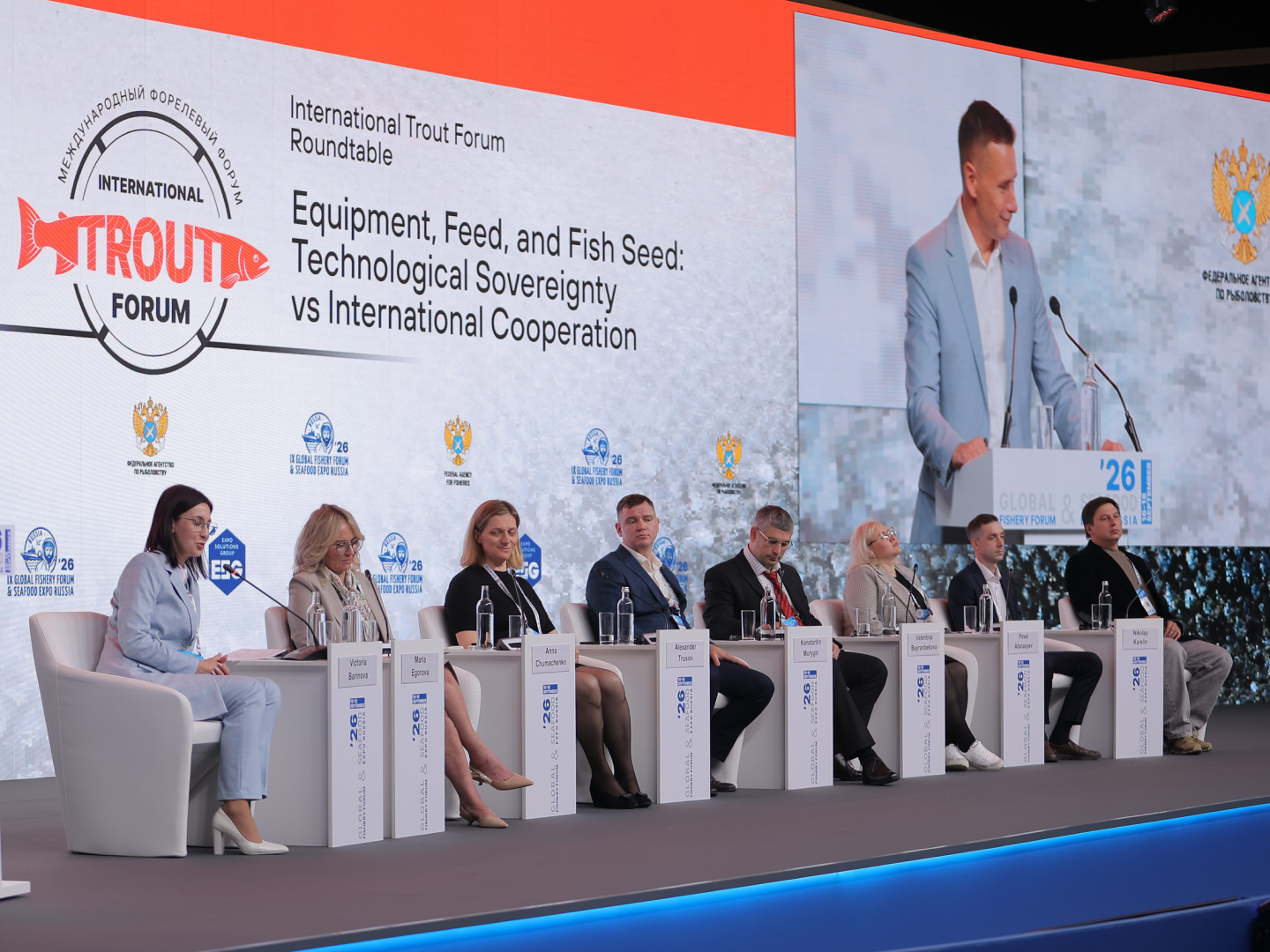
At the International Trout Forum roundtable "Equipment, feed and fish seed: technological sovereignty vs international cooperation", representatives of research, business and industry organisations discussed the main constraints on the development of trout farming, from genetics and seed stock to feed, equipment and fish health solutions. One proposal was to establish a consortium bringing together manufacturers, research institutions and fish farms.
The Karelia breeding centre is expected to supply domestic seed stock
Aleksey Myshkin, Head of the Freshwater Fisheries Branch at VNIRO, noted that developing a domestic genetic base requires a systematic approach to broodstock management. He estimated that at least six breeding facilities would be needed, each capable of producing around 50 million eggs.
"We need at least six breeding facilities, each producing at least 50 million eggs. Together, they would provide the 300 million eggs required by fish farms," Aleksey Myshkin explained.
The establishment of selective breeding centres is another important part of this work. Pavel Afanasyev, Head of the Aquaculture and Fishery Resources Restoration Directorate at Glavrybvod, said that a new centre in Karelia is expected to open by the end of 2026. The project includes two isolated production lines and is designed to produce up to 25 million eyed eggs and up to 10 million fry weighing more than 10 grams.
"Equipment commissioning is currently under way, and the centre is scheduled to become operational before the end of this year," Pavel Afanasyev said.
Developing Russia's domestic genetics will remain a long-term task. Individual solutions may become available over the next few years, but establishing a comprehensive genetic base will take considerably longer.
Producers propose pooling expertise through a consortium
Andrey Martynov, CEO of Chernomorskaya Forel LLC, proposed moving from separate projects towards cooperation between research institutions, feed producers, veterinary companies and fish farms. In his view, such a consortium could include several research institutes, three or four feed manufacturers, fish producers and major farms.
"We will not achieve anything working in isolation," he said, stressing the need to coordinate work on genetics, vaccines and other technologies.
Feed producers identify the main challenges facing trout farming
Further development of trout farming requires several systemic issues to be addressed, both in production efficiency and industry infrastructure. This was highlighted by Anna Chumachenko, Marketing and Communications Director at JSC Fish Feed.
"What challenges do we see? First and foremost, biosecurity, trout genetics and selective breeding, management of retail trout prices, increasing exports of Russian fishmeal and fish oil and developing the industry's knowledge base," Anna Chumachenko said.
Among the proposed solutions, she highlighted the development of farm support services covering the entire production cycle from feed to market-sized fish, the launch of a starter feed line producing 0.5 mm pellets, the creation of facilities for microbiological and fish disease research and the development of preventive and therapeutic feeds. The company is also working with specialised research institutes to develop a vaccine for freshwater trout.
Maria Egorova, Member of the Board of Directors and Deputy General Director – Commercial Director of MELKOM Group JSC, noted that the feed industry has already expanded its production capacity significantly. At the same time, it remains dependent on imported raw materials.
"For feed producers, the main challenge is raw materials. Fish oil and fishmeal account for 70% of the cost of premium-quality feed," Maria Egorova said.
According to Egorova, domestic production of fish oil and fishmeal is declining, forcing feed manufacturers to look abroad for high-quality raw materials. Against this background, she identified alternative protein sources as a potential area for further development.
"Sooner or later, we will have to determine how to make feed more affordable without compromising on quality. This will be one of the most important challenges we need to address in the near future," she added.
Egorova believes that the development of domestic aquaculture remains one of the main drivers of growth for Russian feed production. She identified Uzbekistan and Kazakhstan as potential export markets.
International cooperation could accelerate technology localisation
Alexander Trusov, Development Director at Turkish company ASAKUA and Chairman of the International Aquaculture Association INFRAGROUP, stressed that technological sovereignty does not necessarily mean developing every solution from scratch. International technologies can provide a foundation for localisation through the adaptation of equipment and the development of Russian software.
Technological independence is also closely linked to farm infrastructure. Representatives of NGCO New Gas Company and Qihang Fishing Cage Rus presented solutions for oxygen supply, automated feeding and the development of cage farming systems.
Biosecurity is becoming part of production efficiency
A separate part of the discussion focused on disease prevention. Valentina Bayranbekova, Head of the Fish Farming Department at Raciovet LLC, stressed the need for a comprehensive biosecurity system covering water quality control, sanitation procedures, fish health monitoring and staff training.
Valeria Evgrafova, Head of the Laboratory for the Prevention of Bacterial Diseases at the Federal Center for Animal Health, presented the organisation's work on vaccines for freshwater trout. Participants also discussed the need to improve the regulatory framework for reproduction technologies.
The discussion showed that the development of Russian trout farming depends not on a single area of import substitution but on an integrated approach combining genetics, feed, fish health, equipment and production expertise. Participants stressed the need for closer coordination between these areas and more active use of international experience in developing domestic technological solutions.