



September was an important month for Russia's fisheries sector. The industry's achievements and future development, domestic fish consumption, shipbuilding, international cooperation and exports all featured prominently on the federal agenda. The IX Global Fishery Forum & Seafood Expo Russia carried this agenda forward, welcoming 20,673 industry professionals fr om 82 Russian regions and 84 countries. A total of 339 companies and organisations from 38 Russian regions and 11 countries exhibited their products and services. Russian President Vladimir Putin sent greetings to participants and guests. Earlier in Vladivostok, he had inspected the modern supertrawler Kapitan Yunak, built under Russia's investment quota program. The scale and substance of the Forum and Exhibition once again demonstrated their importance to the steady development of the fisheries sector.
Consumption as the starting point
Increasing domestic fish consumption and strengthening the position of Russian-caught fish and seafood on global markets remain central themes of the Forum and Exhibition. New discussion formats broadened the program, covering issues from the resource base for capture fisheries to new areas of cooperation with BRICS+ countries. The inaugural International Trout Forum also joined the program of the industry's flagship event in St Petersburg. Its strategic session brought together government officials, researchers and leading production and infrastructure companies specialising in trout and salmon farming from Russia, Türkiye, China, Iran and other countries.
International cooperation received particular attention throughout this year's event. On its sidelines, Ilya Shestakov, Head of the Federal Agency for Fisheries, held working meetings with delegations from China, Indonesia, Sierra Leone, Guinea-Bissau, Madagascar, Mauritania, Türkiye, Cuba, Venezuela, Vietnam, Côte d'Ivoire, Iran and the Kyrgyz Republic. The dialogue with the Kyrgyz delegation took place during the official tour of the exhibition.
As in previous years, the business program covered every stage of the fish and seafood value chain, from catch to retail. It addressed shipbuilding and ship repair as well as aquaculture and mariculture, which were also showcased in the dedicated Ship Tech Global and Aqua Farm Global special expositions.
Market trends on the exhibition floor
The extensive exhibition across two pavilions gave a practical dimension to discussions on the production and promotion of fish and seafood for consumer markets, exports and imports, digitalisation and other modern technologies in fishing and monitoring, science and workforce development, the cold chain and more. Major Russian and international companies exhibited alongside many small and medium-sized businesses, presenting products, services, technologies and solutions.
More than 70 international companies took part as exhibitors. Iran and the Kyrgyz Republic each presented a joint national pavilion for the first time. Companies from India, the Republic of Korea, China, Pakistan, Thailand, Türkiye, Belarus and other countries also joined the exhibition.
New exhibitors included several leading canned fish producers from Central Russia and a broad group of aquaculture and mariculture companies from Russia and abroad. They joined Aqua Farm Global, which continued its rapid expansion. This year, the exposition added a second recirculating aquaculture system (RAS), enabling participants to demonstrate their equipment and technologies in operation.
Answering the main question
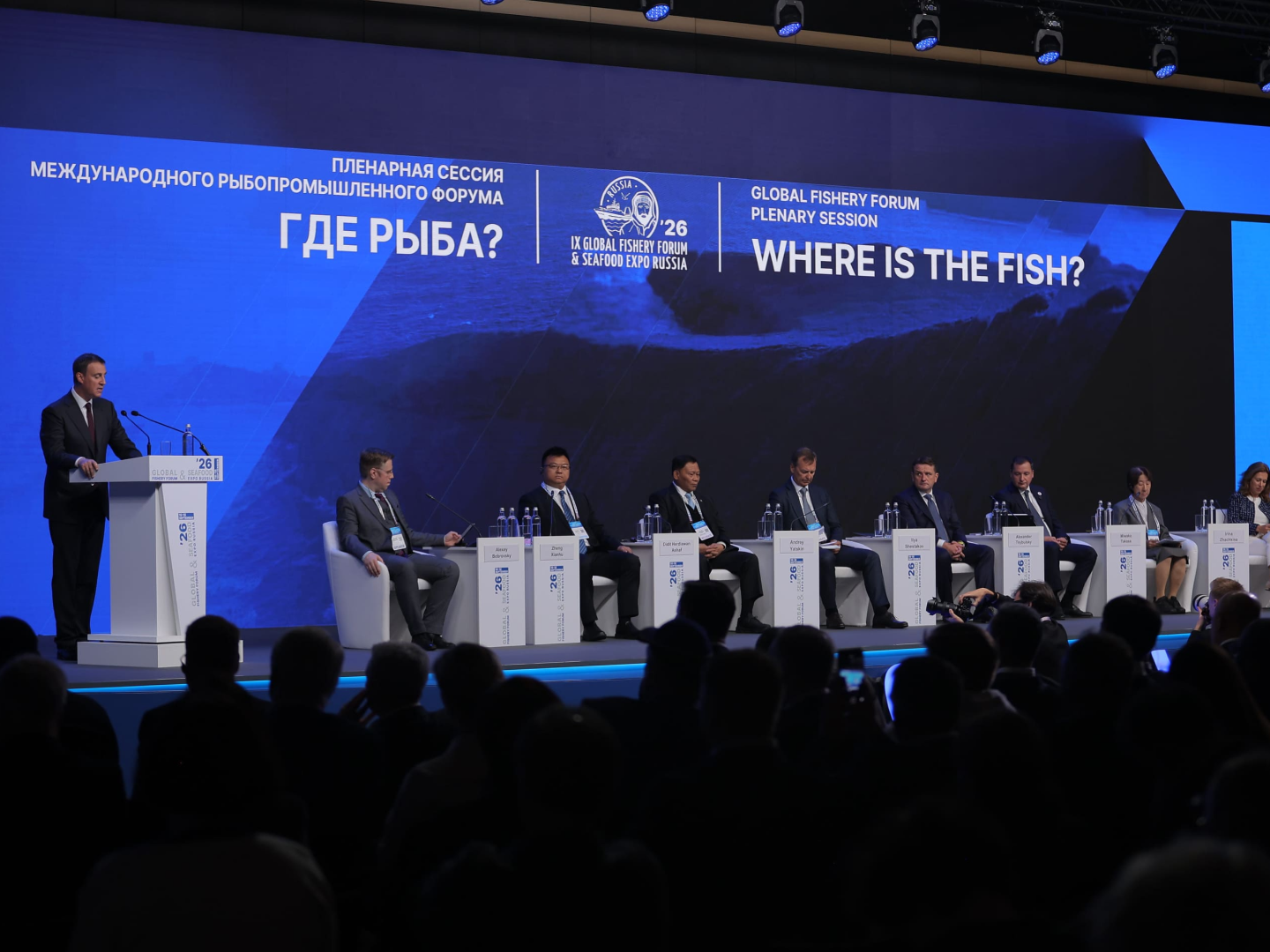
The Plenary Session "Wh ere Is the Fish?" was the centrepiece of the three-day program, bringing together the findings of discussions held throughout the event. Opening the session, Dmitry Patrushev, Deputy Chairman of the Government of the Russian Federation, said that Russia's fisheries sector still had considerable potential for further growth. At the same time, it now faced new challenges that required the industry not only to adapt to change, but also to anticipate which resources would be available in the future.
Continuing the discussion, Ilya Shestakov, Head of the Federal Agency for Fisheries, noted that the resource base was developing differently across species and fishing basins: some stocks were growing, some remained stable and others were declining. Fisheries management therefore needed to respond quickly to change while remaining grounded in science. Digitalising fishing operations was one tool for making management more effective.
Participants also highlighted the progress already made in modernising the industry's production capacity and proposed measures to sustain that progress, including further development of value-added processing and closer integration across the fish and seafood value chain.
Zheng Xianhu, Director of the Heilongjiang Fishery Research Institute, Chinese Academy of Fishery Sciences (CAFS); Miwako Takase, Managing Director of the Japan Fisheries Association; and Didit Herdiawan Ashaf, Vice Minister of Marine Affairs and Fisheries of the Republic of Indonesia, shared their countries' experience in maintaining a stable supply of fish products to domestic and export markets amid changes in resource availability and market conditions.
Established traditions and new formats
The Main Arena once again hosted events celebrating the industry's achievements and its people. Awards were presented to the winners of the "Best Fishery Product" Competition, recipients of the Russian Fishery Company's Golden Pollock Award, and recipients of the "Fish Day Every Day" Award for Contributions to the Promotion of Seafood Consumption.
The Federal Agency for Fisheries presented departmental honours and recognised the winners of the All-Russian "Professionals" Competition in Fisheries Competencies, as well as the recipients of the FishCorr National Journalism Award.
The Forum and Exhibition also provided a platform for major cooperation agreements and memoranda. Eighteen were signed in a formal ceremony on the Main Arena before industry representatives and the media.
The informal program included the industry football match for the third consecutive year, held at Petrovsky Stadium for the first time. The friendly between teams representing the organisers and exhibitors was open to all Forum and Exhibition participants and visitors. Russian football legends Alexander Kerzhakov, Andrey Karyaka, Dmitry Sychev, Pavel Pogrebnyak, Vladimir Gabulov and Alexander Samedov joined the teams on the pitch.
After the Forum and Exhibition, the Fish Gastronomic Festival "Russian Fish" brought the industry closer to consumers at the Brusnitsyn Cultural Quarter. The festival introduced a wider audience to the range of fish and seafood available on the Russian market and helped promote fish consumption through restaurants and other foodservice businesses.
The Global Fishery Forum & Seafood Expo Russia is organised by the Federal Agency for Fisheries with the support of the Ministry of Agriculture of the Russian Federation. Expo Solutions Group LLC is the industry exhibition operator.
Partners and the sponsor of the Forum and Exhibition: Rosselkhozbank JSC (General Sponsor), Fishery Shipowners Association (Business Program Partner), Moreodor LLC (Registration Zone Partner), FishStat LLC (Digital Partner), ANTEY Group (Football Match Partner), PJSC MMC Norilsk Nickel (Partner), Sberbank PJSC (Partner), Murman LLC (Partner), MELKOM Group JSC (General Partner of Aqua Farm Global), Fish Feed JSC (Official Partner of Aqua Farm Global), VALCOM LLC (Official Partner of Ship Tech Global), Nautic Rus LLC (Partner of Ship Tech Global), and the All-Russian Association of Fisheries Enterprises, Entrepreneurs and Exporters (VARPE) (Industry Partner of the Exhibition).