



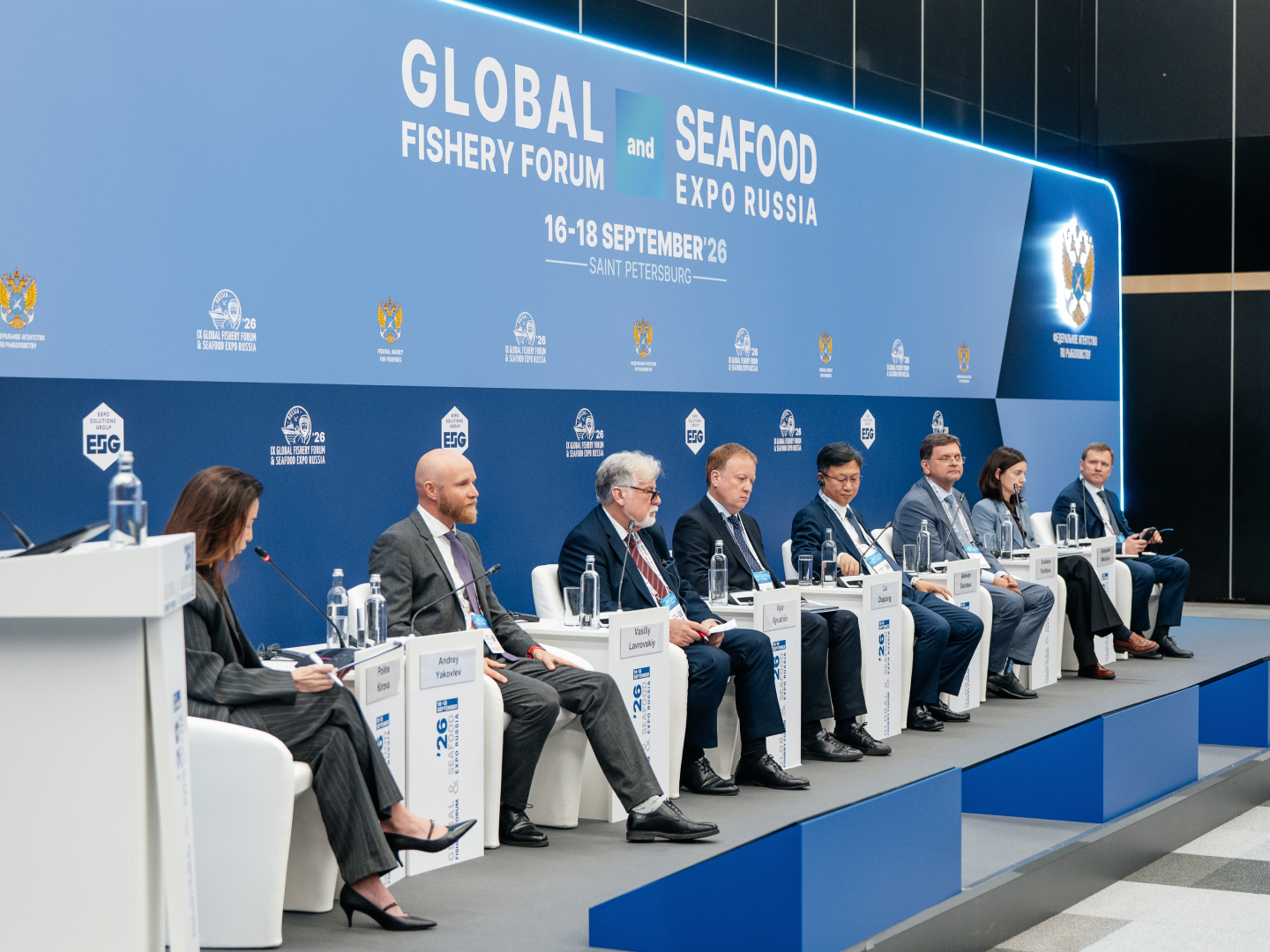
The roundtable "BRICS Fishery Trade Routes: Russia's Export Potential" was held as part of the business program of the IX Global Fishery Forum & Seafood Expo Russia. The event was organised by the Fishery Shipowners Association. Participants discussed trends in Russian fish exports, barriers in BRICS markets and opportunities to increase supplies, including high value-added products.
Opening the roundtable, Andrey Yakovlev, Deputy Head of the Federal Agency for Fisheries, noted that BRICS countries account for a significant share of global fish production and consumption. For Russia, cooperation within BRICS provides an opportunity to diversify foreign trade and develop its export supply chain.
"Our task is not only to increase supply volumes. We also need to develop advanced processing and build a long-term presence for Russian companies in the markets of the member states," Andrey Yakovlev said.
He noted that BRICS already brings together considerable production and technological resources. However, its member countries differ in terms of industry structure, consumption levels and product requirements, making it essential to consider the specific characteristics of each market.
The speaker also addressed existing barriers. Import duties on certain products in India, for example, reach 30%, while Russian suppliers operating in Brazil face high logistics costs and import tariffs. Andrey Yakovlev identified differences in certification requirements as a common systemic barrier. As a long-term solution, he proposed considering the creation of a unified certification system for fish products within BRICS.
Vasily Lavrovsky, Advisor to the Head of the Federal Service for Veterinary and Phytosanitary Surveillance (Rosselkhoznadzor), noted that the diversity of BRICS countries is both a distinctive feature and an advantage of the association. He said that one way to develop the certification system would be the gradual introduction of electronic information systems that make it possible to trace product origins. He also highlighted the gap between the number of Russian companies and vessels already authorised to enter BRICS markets and the actual volumes supplied. Entering a new market requires not only completing the approval procedures but also establishing a consistent approach to working in that market.
Data on Russian fish export trends was presented by Ilya Ilyushin, Head of Agroexport. He said that Russia exported more than 2 million tonnes of fish and seafood worth over $6 billion last year. In the first half of 2026, the value of Russian fish exports increased by 27%. Exports to BRICS countries rose 2.7-fold in value over the past five years and exceeded $3 billion in 2025. In the first half of 2026, supplies to the association's member countries increased by a further 1.5 times compared with the same period a year earlier.
China remains the primary destination. However, according to Ilya Ilyushin, export trends in other countries also demonstrate opportunities for diversification. Compared with 2021, the value of Russian fish exports increased 2.6-fold to China, sixfold to Brazil and 69.6-fold to India.
Lyu Daqiang, Chairman of Liaoyu Group Co., Ltd, spoke about the Chinese company's long-standing cooperation with Russia's fisheries sector. He said that practical cooperation has continued for more than 30 years. In 1992, Liaoyu Group's port became the first transit port in China for Russian fish products. During the first eight months of 2026, the company's imports fr om Russia increased by 62% in volume and 31% in value.
Thamires Quinhões, Executive Director of ABRAPES, discussed the prospects for Russian exports to Brazil. She noted that Brazil is a major consumer market wh ere imports play an important role in meeting domestic demand. In 2026, the country imported around 216,000 tonnes of seafood worth $1.21 billion. Russian pollock, cod and finished products are being supplied to Brazil in 2026. Thamires Quinhões said that Brazilian consumers and foodservice businesses are showing interest in finished products, creating opportunities to increase supplies of more highly processed products.
Alexey Buglak, President of the Pollock Harvesters Association, noted that China remains a key market for Russian exports. However, further growth will depend on diversifying export destinations and increasing the share of processed products. He said that Russian whitefish exports rose by around 21% in the first half of 2026. During the same period, Russia supplied Brazil with 71.1 tonnes of salted and dried cod and 15 tonnes of frozen cod.
Alexander Timchenko, Representative of the Ministry of Agriculture of the Russian Federation in the Republic of South Africa, spoke about opportunities in the South African market. Russia's presence in the country remains relatively limited, but the structure of supplies is changing. He identified greater exports of high value-added products, diversification of the product range and direct contacts with importers, distributors and retail chains as promising areas for further development. Stable supplies, a suitable product range, appropriate packaging and a clear logistics model are essential for successfully entering the market.
Svetlana Panfilova, Deputy Governor of Murmansk Oblast and Minister for Arctic Development and Economy of Murmansk Oblast, described the role of BRICS countries in the region's exports. She noted that the fisheries sector remains one of the foundations of the Murmansk Oblast economy, while exports are strategically important for regional businesses. In 2025, around 73% of the region's crab harvest and 45% of its fish catch were exported. By the end of the year, China accounted for around 25% of the region's total fish product exports.
Exports of high value-added products, including crab and sea urchin products, are also increasing. Svetlana Panfilova noted growing interest in Murmansk Oblast products from Brazil. A regional company specialising in deeply processed products is currently increasing its supplies to the Brazilian market.
Concluding the discussion, Alexander Mikhailov, Head of the Centre for Fisheries Monitoring and Communication System, spoke about the development of electronic certification for Russian fish exports. The system was developed using experience gained through cooperation with China and the Republic of Korea. Its development began in 2022 and it became fully operational in 2025. A total of 3,770 electronic certificates were issued in 2025, accounting for 64% of all documents processed. The speaker highlighted the advantages of the electronic system, particularly faster processing, and proposed considering the creation of a universal certificate for BRICS markets.
Summing up the roundtable, moderator Polina Kirova, an expert in Russia's fisheries sector, noted the participants' interest in developing trade in fish products between Russia and other BRICS countries. The experts identified the reduction of tariff, logistics and certification barriers, market diversification and a greater share of deeply processed products as the key conditions for further growth in Russian exports.