



Global Fishery Forum & Seafood Expo Russia
September, 16-18, 2026, Saint Petersburg
September, 16-18, 2026, Saint Petersburg
25/05/2026
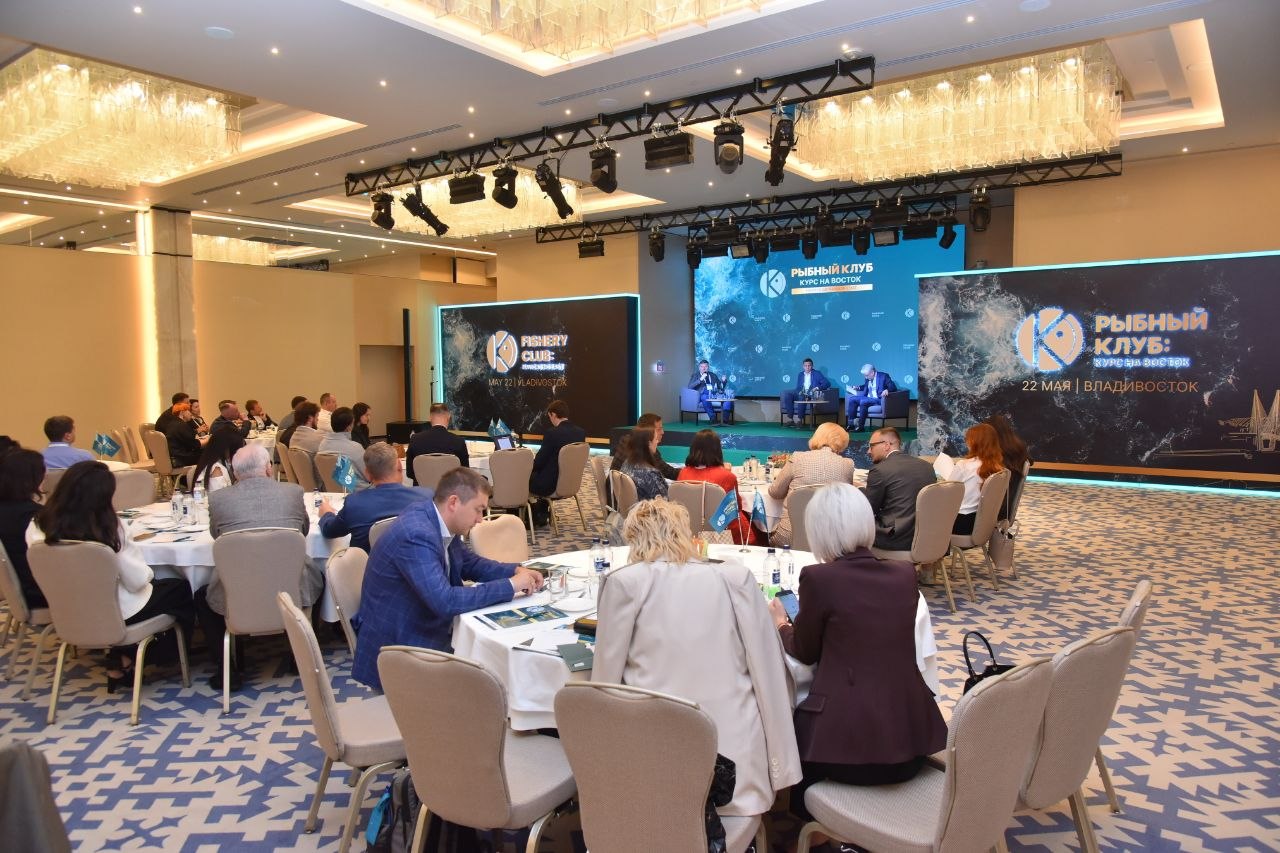
On May 22, the Fishery Club met in Vladivostok, bringing together around 100 participants, including executives from fishing and processing companies, logistics operators, industry associations, and infrastructure enterprises. The central topic of the discussion was how the Russian fisheries sector can increase the added value of its products while diversifying export flows.
The meeting was structured as an open discussion with strong audience participation, where the focus was not on formal presentations but on practical dialogue – covering logistics, contract models, and approaches to foreign market development.
How resilient is the current export model amid high market concentration?
The discussion opened with an analysis of export structure. More than half of Russia’s seafood exports currently go to China, and together with South Korea and Japan, these three Asian markets account for the overwhelming majority of shipments.
Participants noted that China will remain a key partner for years to come, but such concentration creates structural risks – including pricing pressure, logistical dependency, and regulatory exposure. The challenge is not to leave this market, but to build a “safety buffer” through diversification.
Polina Kirova, an expert in seafood marketing and Acting CEO of the consulting and analytics company Sevir, emphasized that diversification is not just about entering new countries, but about understanding local demand and consumption patterns. One of the discussed directions was Africa, where fish is traditionally consumed. However, success in new markets depends entirely on product-market fit – including processing format, size, packaging, and price positioning.
The practical side of entering alternative markets was illustrated by Andrey Buzin, Commercial Director of Okeanrybflot, who shared experience of exports to Latin America. He pointed to infrastructure constraints such as inspection delays and unpredictable logistics. Even with strong demand, deals can fail due to vessel downtime.
Logistics challenges were further addressed by Andrey Grechkin, CEO of Dalretrans, who noted that logistics can no longer be seen as a purely service function. It now directly determines product competitiveness and the ability to enter new markets.
Eduard Klimov, co-organizer of the Fishery Club meetings and Chairman of the Board of Fishnews media holding, raised a cross-cutting question for the entire session:
“As the industry is increasingly pushed toward deeper processing, in Asia the highest margins are often generated by live seafood with minimal processing. So what exactly should we be offering new markets?”
What should the industry focus on – and can it learn from other agribusiness sectors?
This question was further explored by Konstantin Korobkov, CEO of YUKRK, who highlighted how different product categories require different market logics. He also shared experience in producing fishmeal and fish oil according to international standards and organizing trial shipments to global industrial hubs.
A separate discussion block focused on vertical integration and lessons from other agricultural sectors that have already built transnational market models. Co-moderator of the second session, Kirill Kostyna, Managing Director at Rosselkhozbank’s Large Corporate Business Division l, spoke with Alexander Remeta, CEO of Antey Asset Management.
Remeta shared insights from the meat industry, where full vertical integration from farm to retail abroad is possible, but requires significant investment in processing and branding. This naturally raised the question of how transferable such a model is to fisheries.
Fishnews.ru Editor-in-Chief Margarita Kryuchkova asked representatives of Rosselkhozbank what financial instruments could support export-oriented transformation in the fisheries sector, especially under current constraints in cross-border payments, currency regulation, and alternative settlement systems.
Elena Bakumenko and Maxim Ardatov presented specialized tools for exporters, including financing, settlements, and analytical support. However, they stressed that without a predictable payment infrastructure, discussions about export diversification remain largely theoretical.
Successful export today requires not only logistics and pricing strategies, but also a clear understanding of how a product exists within a specific market ecosystem – including business models already proven in other agrifood sectors.
Promotion does not exist in a vacuum
This issue became central in the third session, moderated by Polina Kirova, Eduard Klimov, and Alexey Merkulov, Communications Director at RRPK.
The discussion started from a key observation: the significant gap between the export price of Russian seafood and its final retail or HoReCa price abroad. This gap represents untapped value that can be managed more effectively if the entire supply chain is considered.
Alexey Merkulov presented practical examples of promoting Russian processed seafood and marine products in Asian markets – from crab to ready-to-eat products and snacks. He emphasized that promotion is impossible without understanding the end consumer:
“Do you actually know where your product is sold and how much it costs in foreign retail?”
A key perspective was added by Alexey Buglak, who focused on pollock – the largest segment of Russian seafood exports. He explained that value creation depends not on raw material exports, but on structured product offerings. The Chinese market, he noted, requires precise specifications, consistent quality, and a clear understanding of end use. Assuming that a Chinese partner will “figure it out themselves” leads to lost margins.
He also stressed that distribution in China is highly fragmented, packaging requirements are stricter, and price formation requires a different level of commercial competence. In continuation, Evgeny Chizh, CEO of FishStat, presented digital tools that enable communication with international buyers.
Shared conclusions from the Vladivostok Fish Club
Participants converged on several key conclusions. Export diversification is not an alternative to working with China, but a necessary risk mitigation strategy. Margins do not automatically increase with deeper processing – in Asia, live products may be more profitable, while in other regions processing adds value. There is no universal model.
Logistics and payment infrastructure are critical constraints of the export system. Marketing and promotion only work when they are tied to a specific product, designed for a specific market, with clear specifications and pricing logic.
Georgy Martynov, President of the Primorsky Fisheries Association, noted that systemic challenges cannot be solved without industry initiative, which is why Fish Club meetings in Vladivostok are expected to become an annual platform.
In closing, Ivan Fetisov, CEO of ExpoSolutions Group, emphasized that the first meeting was intended to frame key systemic questions around export sustainability and value creation through better coordination within the fisheries ecosystem. He stressed the importance of maintaining a dialogue-driven format going forward.
The organizers thanked all participants, partners, and industry associations for their contribution to a meaningful and substantive discussion.
“Fishery Club: Course to the East” was organized jointly by Expo Solutions Group and Fishnews media holding.
General sponsor: Rosselkhozbank
Partners: RRPK and FishStat
The meeting was structured as an open discussion with strong audience participation, where the focus was not on formal presentations but on practical dialogue – covering logistics, contract models, and approaches to foreign market development.
How resilient is the current export model amid high market concentration?
The discussion opened with an analysis of export structure. More than half of Russia’s seafood exports currently go to China, and together with South Korea and Japan, these three Asian markets account for the overwhelming majority of shipments.
Participants noted that China will remain a key partner for years to come, but such concentration creates structural risks – including pricing pressure, logistical dependency, and regulatory exposure. The challenge is not to leave this market, but to build a “safety buffer” through diversification.
Polina Kirova, an expert in seafood marketing and Acting CEO of the consulting and analytics company Sevir, emphasized that diversification is not just about entering new countries, but about understanding local demand and consumption patterns. One of the discussed directions was Africa, where fish is traditionally consumed. However, success in new markets depends entirely on product-market fit – including processing format, size, packaging, and price positioning.
The practical side of entering alternative markets was illustrated by Andrey Buzin, Commercial Director of Okeanrybflot, who shared experience of exports to Latin America. He pointed to infrastructure constraints such as inspection delays and unpredictable logistics. Even with strong demand, deals can fail due to vessel downtime.
Logistics challenges were further addressed by Andrey Grechkin, CEO of Dalretrans, who noted that logistics can no longer be seen as a purely service function. It now directly determines product competitiveness and the ability to enter new markets.
Eduard Klimov, co-organizer of the Fishery Club meetings and Chairman of the Board of Fishnews media holding, raised a cross-cutting question for the entire session:
“As the industry is increasingly pushed toward deeper processing, in Asia the highest margins are often generated by live seafood with minimal processing. So what exactly should we be offering new markets?”
What should the industry focus on – and can it learn from other agribusiness sectors?
This question was further explored by Konstantin Korobkov, CEO of YUKRK, who highlighted how different product categories require different market logics. He also shared experience in producing fishmeal and fish oil according to international standards and organizing trial shipments to global industrial hubs.
A separate discussion block focused on vertical integration and lessons from other agricultural sectors that have already built transnational market models. Co-moderator of the second session, Kirill Kostyna, Managing Director at Rosselkhozbank’s Large Corporate Business Division l, spoke with Alexander Remeta, CEO of Antey Asset Management.
Remeta shared insights from the meat industry, where full vertical integration from farm to retail abroad is possible, but requires significant investment in processing and branding. This naturally raised the question of how transferable such a model is to fisheries.
Fishnews.ru Editor-in-Chief Margarita Kryuchkova asked representatives of Rosselkhozbank what financial instruments could support export-oriented transformation in the fisheries sector, especially under current constraints in cross-border payments, currency regulation, and alternative settlement systems.
Elena Bakumenko and Maxim Ardatov presented specialized tools for exporters, including financing, settlements, and analytical support. However, they stressed that without a predictable payment infrastructure, discussions about export diversification remain largely theoretical.
Successful export today requires not only logistics and pricing strategies, but also a clear understanding of how a product exists within a specific market ecosystem – including business models already proven in other agrifood sectors.
Promotion does not exist in a vacuum
This issue became central in the third session, moderated by Polina Kirova, Eduard Klimov, and Alexey Merkulov, Communications Director at RRPK.
The discussion started from a key observation: the significant gap between the export price of Russian seafood and its final retail or HoReCa price abroad. This gap represents untapped value that can be managed more effectively if the entire supply chain is considered.
Alexey Merkulov presented practical examples of promoting Russian processed seafood and marine products in Asian markets – from crab to ready-to-eat products and snacks. He emphasized that promotion is impossible without understanding the end consumer:
“Do you actually know where your product is sold and how much it costs in foreign retail?”
A key perspective was added by Alexey Buglak, who focused on pollock – the largest segment of Russian seafood exports. He explained that value creation depends not on raw material exports, but on structured product offerings. The Chinese market, he noted, requires precise specifications, consistent quality, and a clear understanding of end use. Assuming that a Chinese partner will “figure it out themselves” leads to lost margins.
He also stressed that distribution in China is highly fragmented, packaging requirements are stricter, and price formation requires a different level of commercial competence. In continuation, Evgeny Chizh, CEO of FishStat, presented digital tools that enable communication with international buyers.
Shared conclusions from the Vladivostok Fish Club
Participants converged on several key conclusions. Export diversification is not an alternative to working with China, but a necessary risk mitigation strategy. Margins do not automatically increase with deeper processing – in Asia, live products may be more profitable, while in other regions processing adds value. There is no universal model.
Logistics and payment infrastructure are critical constraints of the export system. Marketing and promotion only work when they are tied to a specific product, designed for a specific market, with clear specifications and pricing logic.
Georgy Martynov, President of the Primorsky Fisheries Association, noted that systemic challenges cannot be solved without industry initiative, which is why Fish Club meetings in Vladivostok are expected to become an annual platform.
In closing, Ivan Fetisov, CEO of ExpoSolutions Group, emphasized that the first meeting was intended to frame key systemic questions around export sustainability and value creation through better coordination within the fisheries ecosystem. He stressed the importance of maintaining a dialogue-driven format going forward.
The organizers thanked all participants, partners, and industry associations for their contribution to a meaningful and substantive discussion.
“Fishery Club: Course to the East” was organized jointly by Expo Solutions Group and Fishnews media holding.
General sponsor: Rosselkhozbank
Partners: RRPK and FishStat