



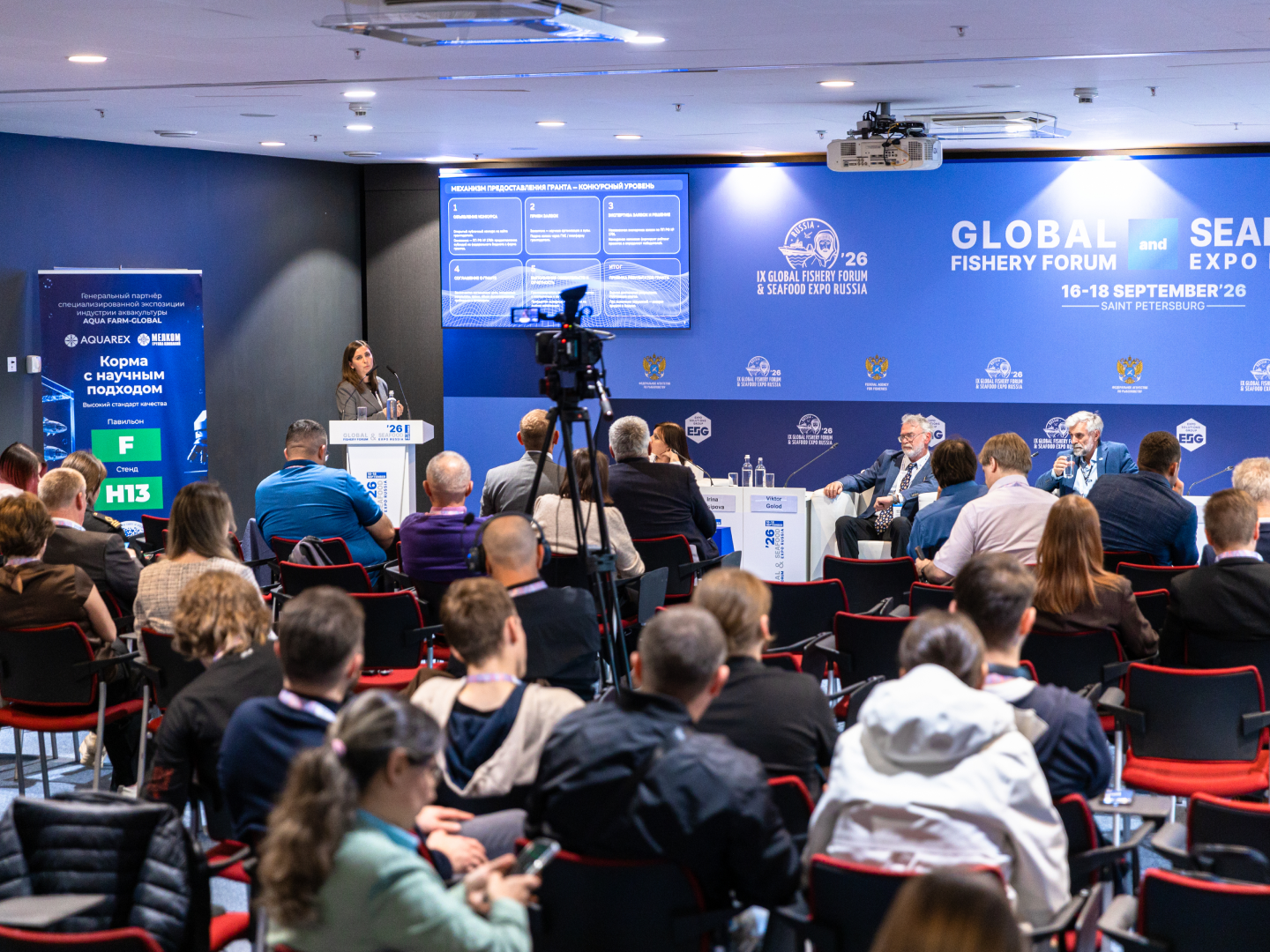
At the Aqua Farm Global roundtable "Selective breeding and genetics in aquaculture: a breakthrough strategy for technological independence", representatives of government, research and business discussed the current state of selective breeding in Russia, advances in genetic technologies, the industry's dependence on imported seed stock and the conditions required to establish a domestic breeding and reproduction system.
The discussion was moderated by Irina Esipova, communications adviser to the head of Glavrybvod. The roundtable was held with the support of Glavrybvod, the Russian Federal Research Institute of Fisheries and Oceanography (VNIRO) and Sfera Media Group.
One of the central topics was the need to build a comprehensive system in Russia in which selective breeding centres develop and improve strains, specialised hatcheries reproduce them and commercial farms receive seed stock tailored to specific production needs.
This was highlighted by Viktor Golod, PhD (Biology), Deputy Director of the Federal Selective and Genetic Center at Glavrybvod. He noted that Russia currently has two major institutions in this field – the Federal Selective and Genetic Center for Fish Farming and VNIRO – both of which require government support. Even modest public funding could help renew and develop breeding stock that meets the needs of Russian producers.
One solution proposed for commercial aquaculture was to involve large farms in producing seed stock for their own needs. This could reduce their dependence on external suppliers while ensuring the volumes and reliability required by major producers.
Nikolay Müge, PhD (Biology), Head of the Department of Genetics and Genomic Selection at VNIRO, outlined the main challenges facing Russian aquaculture:
-
A shortage of seed stock.
-
The use of hormones, particularly methyltestosterone, in fry production.
-
A lack of equipment for the large-scale production of triploid seed stock.
-
A shortage of modern selective breeding centres and specialised breeding facilities.
-
The need to increase production potential.
Nikolay Müge discussed how data can be used to sel ect fish for commercially important traits. Researchers are working with a genetic database for rainbow trout, studying traits related to growth rates and disease resistance and developing genetic profiles. However, genomic selection requires continuous interaction with producers. Assessing the effectiveness of selective breeding requires data directly fr om farms, including stocking figures, harvest weight, feed consumption and other production indicators. This makes it possible to link genetic data to actual production outcomes and use the findings to sel ect strains for further breeding.
Viktoria Averyanova, Head of a Project Area at the Project Office of the Directorate of Scientific and Technical Programs, outlined the available government support mechanisms. Projects are selected through a competitive process followed by independent assessment, the signing of an agreement, implementation of the planned activities and subsequent monitoring. Funding is provided for infrastructure development, equipment purchases, research, technology development and specialist training.
Between 2021 and 2024, the program supported the creation of 35 selective breeding centres, the training of 753 specialists, the registration of 267 intellectual property outputs and the development of 144 technologies. Its new 2025–2027 cycle includes several additional areas, among them the establishment of a genomic selection centre for rainbow trout.
The business perspective was presented by Elena Moiseeva, PhD (Biology), Director of the Ardon-Fish trout fry production company and founder of the FishLab Aquaculture School. She noted that the value of genetics to businesses lies primarily in making production outcomes more predictable. Important traits include body conformation, the proportion of viscera, growth rate, time to maturity, the percentage of stock reaching maturity and the suitability of a strain for the climate of a particular region. She also highlighted disease resistance. Genetic markers make it possible to target resistance to specific diseases and develop strains better suited to Russian conditions.
Viktor Dementyev, Head of the Laboratory of Fish Genetics and Breeding at VNIRO's Freshwater Fisheries Branch, presented an overview of carp breeding. He demonstrated the results of selective breeding projects in Russia and discussed crossbreeding between different breeds. He also addressed the conditions needed to put research findings into practice. According to Viktor Dementyev, the existing procedures for testing and registering new breeding achievements can take considerable time, slowing their adoption by producers.
International experience was presented by Hu Hongxia, Head of Selective Breeding Research at the Institute of Fisheries of the Beijing Academy of Agriculture and Forestry Sciences. She described the approaches used by Chinese researchers in sturgeon breeding and the application of modern genetic tools to commercially valuable traits. Hu Hongxia stressed the importance of hybrid sturgeon breeding for the Chinese market. The current priorities are to shorten the breeding cycle and improve production efficiency.
The discussion identified several priorities for developing Russia's domestic genetic base:
-
Developing domestic selective breeding centres and their infrastructure.
-
Establishing modern broodstock populations.
-
Aligning genetic research with the needs of producers.
-
Supporting in-house production of genetic material by aquaculture companies.
-
Training specialists.
-
Improving government support mechanisms.
-
Expanding international scientific and technological cooperation.
-
Improving the regulatory framework.
Cooperation between research, government and business will be essential to move fr om individual selective breeding projects to a sustainable domestic system for producing aquaculture seed stock.