



September, 16-18, 2026, Saint Petersburg
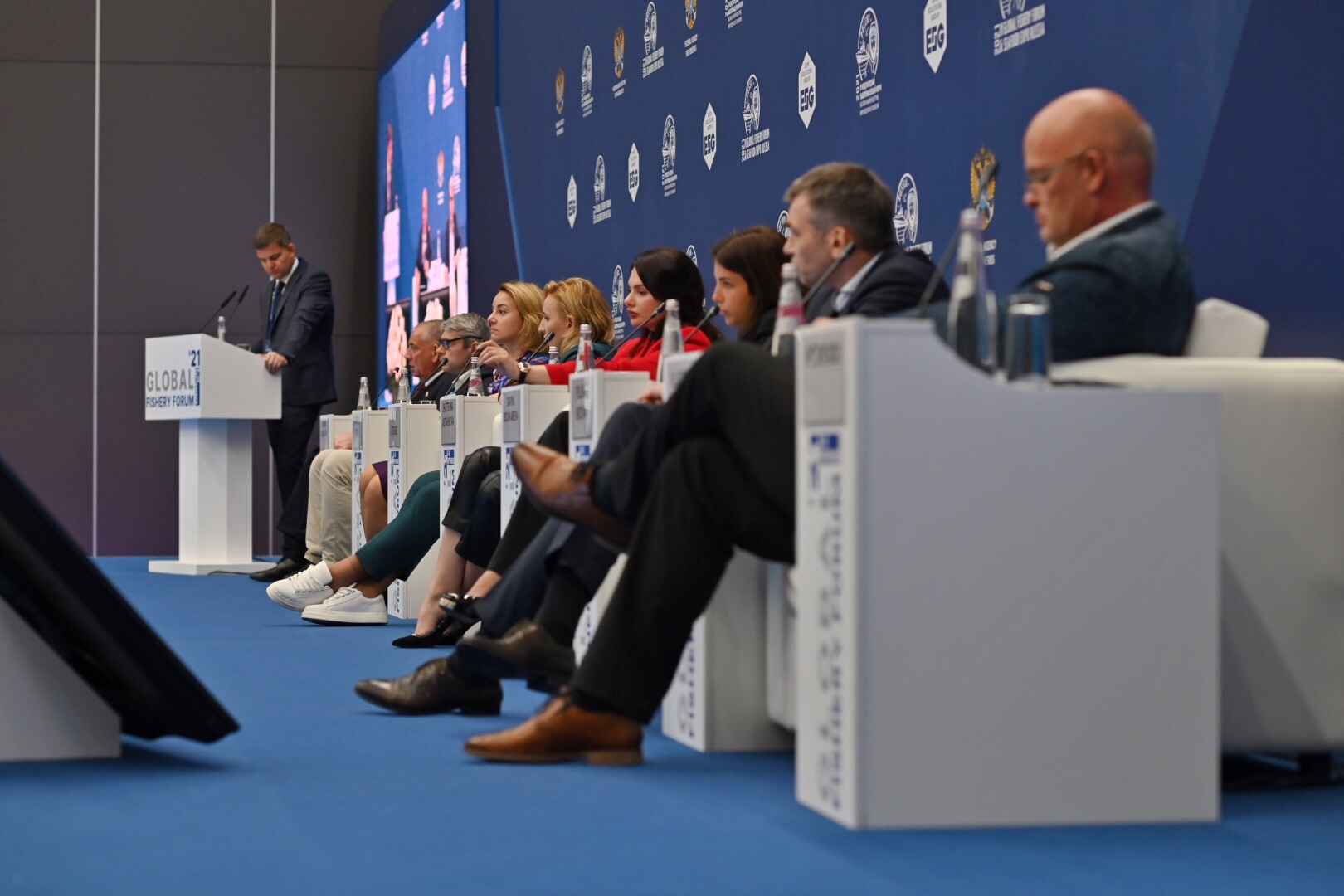
The roundtable “We Have Fish: Who Wants It?” was held on 9 September as part of the IV Global Fishery Forum & Seafood Expo Russia in St Petersburg. A number of problems related to consumption of fish in Russia were discussed.
As mentioned at the session, “over the past 20 years, fisheries have managed to pull themselves out of the chaos, but processing and production are lagging far behind”. Roman Karmanov, Director General of the Presidential Fund for Cultural Initiatives, stressed that fish was a unique and useful product but that, for a number of reasons, it needed to be promoted and popularised.
New capacity
Sergei Mitin, Senior Vice-Chairman of the Federation Council Committee on Agriculture and Food Policy and Environmental Management, outlined the latest measures for developing production of fish products that are in demand. “Investment quotas have yielded results: factory fishing vessels are being built. We have been to all the shipyards: work is going on, competences are coming back. Five vessels are already at the fishery, 33 have been launched, and a total of more than 50 ships are to be built. In addition, 20 onshore fish processing plants have already been completed”, Sergei Mitin reported.
He also referred to the FAO’s forecast of a recovery in global fish consumption and increased production of aquatic bioresources through developing aquaculture and extraction. Russia is predicted to account for most of the growth up to 2030. “This suggests that we need to create strong state support for fish processing and popularisation; we need to ensure consumer demand”, the speaker said.
Who eats fish today?
Garegin Mitin, Secretary of the Council of the Fish Union, shared the results of a study by the Union, X5 and the Platform Strategic Research Centre into how to increase fish consumption in Russia. “Fish, of course, is part of the diet of 88% of the country’s population, but its place in their diet is modest compared to other foods: 6 out of 10 consumers eat fish less than once a week, while the rest do not eat it at all”, said Garegin Mitin.
He said the study had identified two types of fish consumer in Russia: those over 45 years old, the so-called ‘Soviet type’, and younger people in their 30s. Both tend to eat fish, but they buy different products: 41% of younger shoppers buy ready-made fish products, while 51% of older shoppers buy frozen fish and cook it themselves. Meanwhile, 54% of younger people do not eat fish at all, and 45% do not know how to choose it or which kinds of fish are available.
According to Garegin Mitin, the situation is not simple but, if we start popularising fish now, we can bring it back fully into the Russian diet.
Maria Litovko, Vice Governor and Prime Minister of Sevastopol, shared her region’s experience. A new fish processing complex has been opened in the city, a fishing vessel with a displacement of 187 tonnes purchased, and the Social Price project prepared. Fish is promoted in a street food format for the city's residents and tourists, and shop chains and fairs are being opened. “If parents don’t show the variety of fish, the child won’t understand what it is and won’t buy it when they grow up”, Maria Litovko noted.
In turn, Ekaterina Astakhova, CEO of the Nakhodka retail chain, spoke about a study company had conducted. It revealed that many people see fish as an alternative to meat and as a good ‘accompanying product’. Yet, they often do not like to cook fish at home because of its strong smell.
Daria Bochkareva, an expert from the All-Russia People's Front from St Petersburg, noted that the number of fish dishes at school was falling rapidly. “During school years, children's eating habits are formed, and one simply cannot allow fish to disappear from the school menu”, she stressed.
From myth to unity
At the same time, Polina Kirova, Development Director at the Rybset fish supermarket chain, pointed out that “there are positive developments”. “Products are improving, the range is expanding and packaging is becoming more attractive. A lot is also being done by retailers and manufacturers”, she said. “But there is no shift in the consumer's mindset. Why is that? Because all the actions are being taken in a disjointed way.”
Polina Kirova stressed that the buyer sincerely believes all sorts of myths from the Internet and often has no reliable information. She thinks a council needs to be set up to promote Russian fish, focusing on high-quality advertising. Also, a single quality marker needs to be developed that is recognisable and understandable to people, she underlined.
Vladimir Gorelov, CEO of Agama Group, agreed with the speakers: “There are two models of buyer behaviour: the сlassic one, i.e., a person understands fish, and the new one. In the latter case, the understanding of fish's usefulness is reduced, with ready-made meals becoming a priority. The main obstacle now is convenience. Almost none of the products available on the market are suitable for young people!” In his opinion, the consumer now needs fundamentally new products, which means that manufacturers need to step up marketing, R&D and innovation, and direct cooperation between manufacturers and retailers, and even get universities involved in fish popularisation.
Peter Bos, CEO of A.Espersen, says Russian fish exports are set to grow, as the domestic market is unable to absorb all the available abundance. “But we should try to channel these riches to the domestic market, while also ensuring deep processing of raw materials: we need big processing capacities”, he said.
Andrei Mikhalevich, Head of the Economy and Investment Department of the Federal Agency for Fisheries, said the country has sufficient fish resources: Russia has reached a production of 5 m tonnes of wild fish and is actively developing aquaculture.
“Yes, given the global situation, the supply on the domestic market has increased. And, as for processing, 20 new plants have been started up in the last 1.5 years. They are gradually reaching their planned capacity, and this is already beginning to be reflected in the structure of total production: in the first half of 2021, production of the fillets in demand on today’s market has increased by a third – a good result”, said Andrei Mikhalevich.
Commenting on fish promotion, he said that an autonomous commercial supervising organisation is most likely required. “This does not necessarily have to be done on a governmental platform, we have many different producers. I think we should get togther”, Mikhalevich stressed.
The partners include Rosselkhozbank (General Partner), Sberbank (Partner Bank), Norebo Holding (Business Partner), Sigma Marine Technology (Official Partner), Antey (Registration Zone Partner), FEST Group (Strategic Partner), Okeanrybflot (Business Programme Partner), United Shipbuilding Corporation (Partner) and Dobroflot Group (Partner).
Source: Press Office of the Global Fishery Forum & Seafood Expo Russia 2021.